Last updated November 18, 2026
Free written scope consultation - allowances, timeline, and change-order rules on paper before a single trade is scheduled
The Complete Fence Installation Guide for Garden Grove Homeowners
In Garden Grove, one of the most common reasons a new fence ends up in a dispute or gets torn out isn’t bad workmanship. It’s that nobody confirmed the property line before the first post went in. A survey costs a few hundred dollars. Moving a fence costs much more. And moving a fence you built two feet onto a neighbor’s lot means moving it twice: once to take it down, once to put it back where it belonged all along. This guide covers the groundwork most fencing articles skip: Garden Grove’s zone-by-zone height rules, when a permit is required, how Orange County soil and salt air change footing depth, how shared boundary fences work under California law, and how to compare wood, vinyl, aluminum, and block in our climate. We’ve watched too many homeowners start with materials and end with a code correction notice. Start with the rules. The materials will still be there.
Quick Answer
Fence installation in Garden Grove typically runs $3,200 to $9,500 for a standard residential lot, depending on material and length, and most jobs need a property line check and, for block walls or fences over six feet, a city permit. Garden Grove fence height limits vary by yard: front yards are generally capped lower than rear yards, and many homeowners associations enforce stricter rules than the city does. Confirm your property line, your zone, and your HOA’s architectural guidelines before demolition day, not after.
Styles & brands we work with
- Kitchen remodeling
- Bathroom remodeling
- Home additions & ADU
- Roofing
- Windows & doors
- Driveway & pavers
- Fence
Table of Contents
- What Are the Fence Height Limits in Garden Grove?
- When Does a Fence Need a Permit in Garden Grove?
- How Garden Grove Soil, Wind, and Salt Air Affect Post Depth
- Wood, Vinyl, Aluminum, or Block: What Lasts in Orange County?
- Shared Boundary Fences: Who Pays and What California Law Says
- Where HOA Rules Are Stricter Than City Code
- The Step-by-Step Fence Installation Process
What Are the Fence Height Limits in Garden Grove?
Garden Grove breaks fence height rules into three zones, and the limit differs in each. The city’s development code generally allows a front-yard fence lower than a rear-yard fence, with side yards in between and often tied to whether the yard faces a street corner. A common baseline in Garden Grove’s residential zones is a front yard limit around three to four feet and a rear yard limit up to six feet, but the exact number depends on your zoning designation and on whether your lot sits on a corner or an alley. A corner lot can carry a “sight distance” restriction on the street-facing side so drivers can see around the corner, and that often shrinks the allowed height in front without a variance.
Why the zone matters more than the number
Two homeowners on the same street can have different legal fence heights because one lot is zoned R-1 and the other sits in a planned unit development with its own overlay. This is where a national fencing guide falls apart: it can quote a “typical” six-foot limit that simply doesn’t match the code governing your parcel. When we look at a Garden Grove property, we pull the zoning and any overlay before we quote a height. Guessing wrong means building a fence that has to come down.
How to confirm your limit
- Find your parcel’s zoning designation on the Orange County or Garden Grove planning map.
- Check the city development code section for fence heights in that zone.
- Ask whether your lot sits in a planned development or historic overlay with separate rules.
- Read your HOA’s architectural guidelines, which can be stricter, never looser.
- Get the answer in writing before you order materials.
Front-yard fences in Garden Grove also draw more scrutiny because they change the look of the block, and the city handles front-yard projects conservatively. If your lot is a corner, plan for the sight-distance check before you commit to a height.
When Does a Fence Need a Permit in Garden Grove?
A standard wood or vinyl privacy fence at or under the city’s allowed height usually does not require a permit in Garden Grove. But two categories get missed constantly: fences over the allowed height, and block walls.
The block wall classification nobody mentions
Masonry walls, including concrete block, are often classified as structures rather than simple fences, and that pushes them into permit territory even at heights where a wood fence would be exempt. Block walls also carry footing and reinforcing requirements that the city wants an inspector to see. If a contractor tells you a block wall needs no permit, ask them to show you that in the code. In our experience, the block wall is the single most common permit gap on Garden Grove fences.
What triggers an inspection
- Any permitted fence or wall: the inspector typically checks post depth and footings before backfill on masonry.
- Block or masonry walls: reinforcing steel, footing size, and sometimes a compaction check.
- Fences over the allowed height: a permit and sometimes a variance or neighbor notification.
- Retaining walls above a threshold height (commonly a few feet): treated as a separate structural permit, often with soils information.
- Fences on or near a property line with an easement: the city may require a survey or plat before approval.
Permits are where a “cheap” quote gets expensive. A contractor who skips the permit hands you the liability, and when a block wall fails inspection, you’re the one holding the correction notice. We pull the permits and stand for the inspection because the permit inspector works for you, not for us. That’s the whole point.
How Garden Grove Soil, Wind, and Salt Air Affect Post Depth
National fencing guides assume a generic climate. Garden Grove isn’t generic. Our inland Orange County location means hot, dry summer afternoons that shrink and crack soil, followed by winter rain that saturates it, sometimes within days. That wet-dry cycle works on post footings in a way a steady climate doesn’t. A post set too shallow in compacted clay will heave, tilt, and pull the fence rail with it within a couple of seasons.
What actually changes the footing
- Post depth: A common rule is one-third of the post’s above-ground height buried in the ground, but in our clay soils we set deeper, and concrete is standard on load-bearing posts and corners.
- Concrete footing size: Corners, gates, and end posts take more concrete than mid-run posts because they carry wind load and gate weight.
- Wind exposure: Garden Grove’s Santa Ana wind events push hard on solid privacy panels. A six-foot solid panel is a sail; the footing has to be designed for it, not just for gravity.
- Drainage: Posts set in a low spot that holds water rot faster. We check grade before we drill.
- Salt air: Even a few miles inland, marine air accelerates corrosion on steel fasteners and hinges. Stainless or hot-dipped galvanized hardware lasts notably longer than the cheap zinc-plated stuff.
This is a category where the “how much concrete per post” chart in a national guide will fail you. It’s written for a climate with no wet-dry swing and no Santa Ana wind. Use it as a starting point and let someone who works in our soil adjust the number.
Wood, Vinyl, Aluminum, or Block: What Lasts in Orange County?
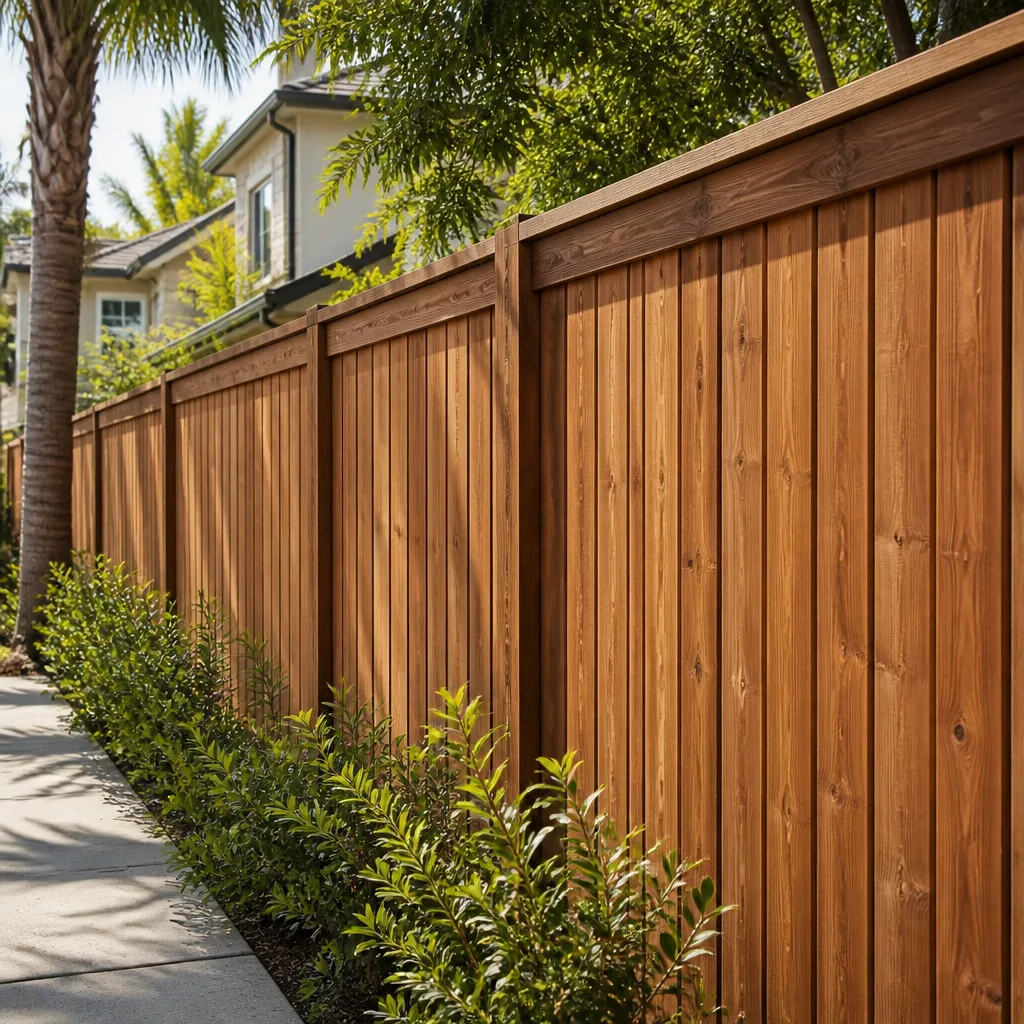
Material choice in Garden Grove is really a question of how much sun, wind, and salt the fence will eat for the next twenty years. Here’s how the four main options hold up here.
Wood
Cedar and redwood handle our climate better than pine, but even good wood needs periodic sealing every few years to fight UV graying and the wet-dry cycle. Wood gives you the most design flexibility and the classic look most Garden Grove neighborhoods expect. It also expands and contracts with our temperature swings, so gate hardware loosens over time and needs tightening. Wood is the least expensive entry point and the most maintenance.
Vinyl
Vinyl holds up well to UV and salt air and doesn’t need painting or sealing, which is why it’s popular in Orange County. The tradeoff is heat: vinyl panels in full sun expand, and a cheap install with no room for expansion buckles or pulls loose. Good vinyl with proper post spacing lasts a long time. Cheap vinyl in direct sun does not.
Aluminum and ornamental steel
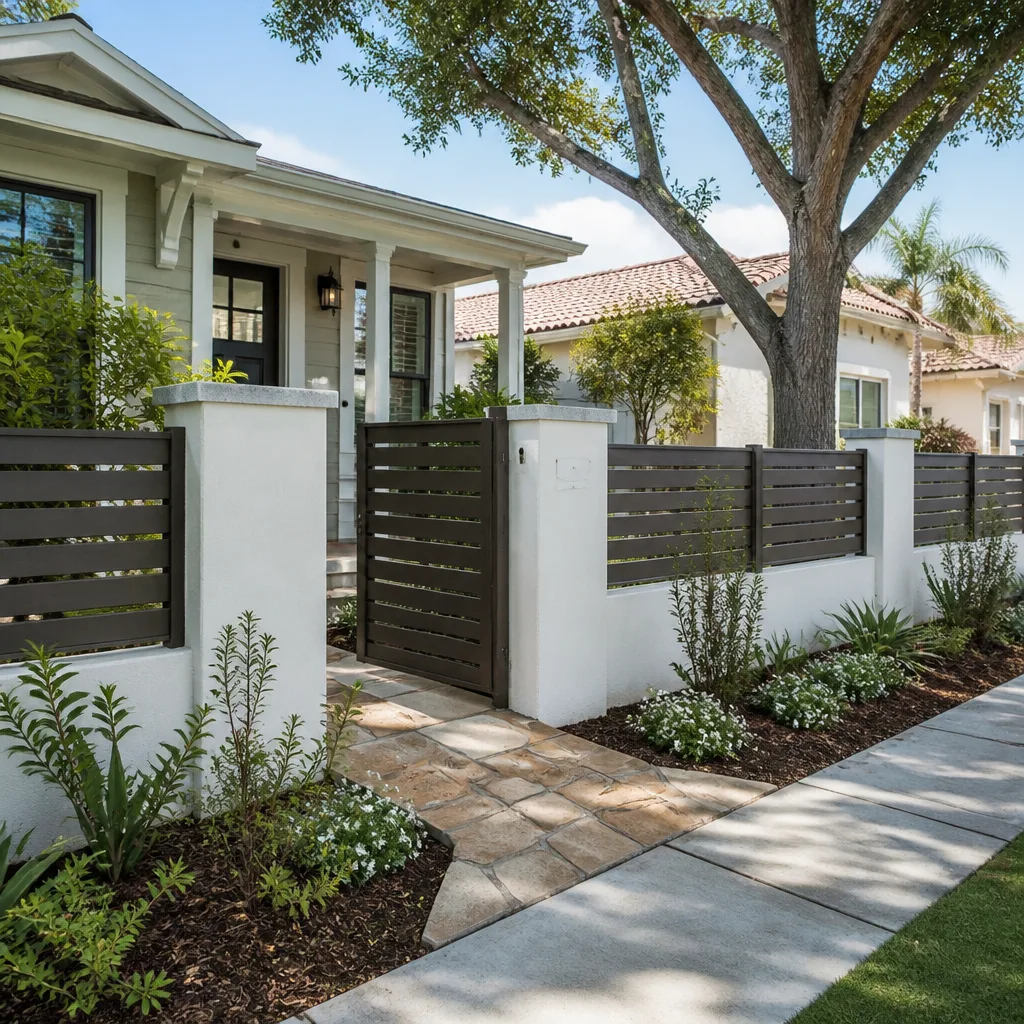
Aluminum and ornamental metal are the best fit for view-fencing and pool barriers, and they handle salt air better than untreated steel. Powder-coated aluminum resists corrosion and doesn’t block sightlines for corner lots where the sight-distance rule bites. Heavier weight per foot than vinyl, more expensive per linear foot, and worth it where you want durability plus an open look.
Block and masonry
Block walls are the most permanent option and the most common boundary wall in this part of Orange County. They’re also the heaviest, the most expensive, and the one material that almost always crosses into permit territory. Block is the right call for a tall privacy wall along an alley or a busy street, and the wrong call for a quick low fence. Reinforcing and footing quality decide whether it lasts or cracks.
Shared Boundary Fences: Who Pays and What California Law Says
Most Garden Grove lot lines already have a fence on them, and most of those fences are shared. What surprises homeowners is that there’s no automatic rule that your neighbor has to split the cost. California’s good neighbor fence law, when it applies, requires a property owner to give written notice and share the cost of a reasonable boundary fence in certain situations, but “reasonable” has room in it, and the process starts with a writing, not a knock on the door demanding half the money.
How to handle it without a dispute
- Confirm the line first. A survey settles whose fence is whose and where the line actually falls. This is the step that prevents most disputes before they start.
- Put the request in writing. State the scope, the proposed material, the height, the cost, and the requested share. A casual verbal ask rarely holds up.
- Set a reasonable deadline. Give the neighbor time to respond and offer to explain the code and any HOA requirements.
- Get the agreement signed. A one-page written agreement noting cost split and ownership is worth every minute it takes.
- Keep receipts. If a dispute later goes to mediation or small claims, the paper trail decides the outcome.
The “who pays” question is settled far more often by a signed one-page agreement than by anyone’s memory of a handshake. We’ve seen neighbors split the cost cleanly and we’ve seen a boundary fence become a filed complaint over six inches and one missing page of paper. The paper is cheaper.
Where HOA Rules Are Stricter Than City Code
Garden Grove has a lot of deed-restricted neighborhoods and planned developments, and this is where a fence that passes city inspection can still be torn out. HOA architectural guidelines typically go further than the city on several fronts: approved materials only (often specific vinyl or block, not wood), a color palette, maximum visiblity from the street, and no front-yard fences at all in some communities. A six-foot wood privacy fence that satisfies the city can violate the HOA if the community allows only a five-foot vinyl or a see-through metal.
What to check before you build
- Approved materials list: does your HOA allow wood, or only vinyl or metal?
- Maximum heights by yard: HOA limits are often lower than the city’s.
- Color and finish: many communities specify a single approved color.
- Architectural review step: most HOAs require an application and approval before you build, not after.
- Boundary fence rules: many HOAs dictate that one side is “finished” facing outward and who maintains the wall.
Read the HOA architectural guidelines before you sign a fence contract, and get the approval in writing. Aesthetic review boards can take weeks, and starting the build before the approval lands is the fastest way to a forced tear-out.
The Step-by-Step Fence Installation Process
A residential fence in Garden Grove typically takes one to three days of on-site labor for a standard run, plus permit and review time if the project requires it. Here’s the order we work in, because the order matters more than the speed.
- Confirm the property line. Pull the survey or plat, or arrange one. Do not skip this.
- Confirm zoning and height. Pull the zone designation and the overlay rules for your parcel.
- Check HOA requirements. Get architectural approval in writing if your community requires it.
- Determine permit need. Over-height fences and block walls almost always need a permit and an inspection.
- Write the scope. Material, height, length, footage, gate hardware, and the finish schedule, all on paper.
- Demo and mark the line. Remove the old fence and mark the post line before any holes get drilled.
- Set posts, then footings. Concrete footings sized for our clay soil and wind load; deeper on corners and gates.
- Install panels and gates. Check gate swing and hardware torque before the crew leaves.
- Pass inspection (if required) and do the walkthrough. Confirm every post, gate, and rail before final payment.
Notice what comes first. Nothing about materials. The legal and logistical groundwork gets done before a single nail moves, and that’s exactly why so many Garden Grove fence projects that fail end up failing for reasons that had nothing to do with the wood or the vinyl.
Common Mistakes to Avoid
- Building without confirming the property line. The most expensive mistake on this list. A fence two feet over the line gets torn out and rebuilt, and the neighbor isn’t required to be gracious about it.
- Assuming the city height limit equals your limit. Your zoning designation and any overlay control the number, and two lots on the same street can differ.
- Treating a block wall like a wood fence. Block walls are usually structures that need a permit, reinforcing, and an inspection. Skipping that step is how a wall fails inspection after it’s built.
- Using national footing charts without local adjustment. Our wet-dry cycle and Santa Ana wind load demand deeper footings and more concrete than a generic climate guide assumes.
- Ignoring HOA architectural review. A city compliant fence can still violate the community’s material and height rules, and the board can require removal.
- Handshaking a shared boundary deal. “We’ll split it” without a signed one-pager is how a friendly agreement becomes a dispute.
- Hiring the cheapest bid without seeing the scope in writing. Cheap quotes usually leave out permits, footings, or gate hardware, and those gaps appear on the final invoice.
See the difference
 Before
 After
 Before
 After
 Before
 After
When to Call a Professional
Some fence projects are weekend work: a short decorative run, a repair, a gate hinge. Others aren’t, and it’s worth naming where the line falls. A block wall, any fence over the allowed height, a boundary fence with a neighbor who hasn’t signed off, a lot with a retaining wall component, or any project that crosses into permit and inspection territory is not a do-it-yourself job. Neither is a fence on a line you can’t confirm, because the survey and the paperwork are the hardest part and the part most likely to cost you. Set-and-concrete post work at six feet with gate load and Santa Ana wind exposure is also no place for a first attempt; a footing that fails in year two takes the whole fence with it. Barrett & Sons Construction Garden Grove offers free estimates in Garden Grove. Call (833) 703-5196. We pull the permits, we put the scope and every change in writing, and the written guarantee stands for 90 days after the job.
Frequently Asked Questions
A standard residential fence in Garden Grove typically runs $3,200 to $9,500 depending on material, length, and gate count, with block walls landing at the higher end and wood at the lower end. Permits and any survey add to the total. Call (833) 703-5196 for an exact quote: estimates are free and the scope comes in writing.
A standard wood or vinyl privacy fence at or under the allowed height usually does not need a permit in Garden Grove, but block walls and over-height fences almost always do. Block walls are commonly treated as structures, which brings footing, reinforcing, and inspection into the project. Call us with your address and we’ll tell you what your parcel needs before you order materials.
Garden Grove limits fence height by yard zone, and the exact number depends on your parcel’s zoning, so front yards typically cap lower than rear yards and corner lots carry a sight-distance restriction. Your HOA can be stricter, never looser. The safe move is to confirm the number in writing before you build. Call (833) 703-5196 and we’ll help you check.
Not automatically. California’s good neighbor fence law, where it applies, requires written notice and cost sharing on a reasonable boundary fence in certain situations, so the process starts with a signed request, not a verbal one. Confirm the property line with a survey first, put the request in writing, and get the agreement signed. Call us if you want a written scope to hand your neighbor.
Yes, if it’s cedar or redwood with periodic sealing and footings set deep enough for our clay soil and Santa Ana wind load. Wood is still the most flexible and least expensive material and the most maintenance. Vinyl and powder-coated aluminum handle UV and salt air with less upkeep and cost more up front. We’ll walk you through the tradeoffs for your lot at the free estimate.
A standard residential fence run typically takes one to three days of on-site labor, with permits, survey work, and HOA architectural review adding time before the crew starts. Block walls and projects on an unconfirmed property line take longer. We give you a start date and a completion window in writing so you’re not guessing. Call (833) 703-5196 to schedule your free estimate.
The Bottom Line
A Garden Grove fence fails for one of two reasons: bad groundwork or a code gap, not bad materials. Confirm the property line before any post goes in, match your height limit to your actual zoning rather than a national guide, treat a block wall as a structure that needs a permit, size your footings for our wet-dry soil and Santa Ana wind, and put any shared-boundary deal in writing. Get your HOA’s approval before you build, not after. Whether you do it yourself or hire it out, the paperwork and the survey decide the outcome, and they decide it before the first post is set. That’s how to keep a Garden Grove fence standing and a neighbor friendly. Our crews have up to 28 years of experience, and Barrett & Sons Construction Garden Grove carries the written guarantee on every job.
If you’re ready to turn the groundwork into a written scope, call (833) 703-5196 for a free estimate, and explore more of what we do:
- Barrett & Sons Construction Garden Grove home
- Fence Installation in Garden Grove
- Driveway & Pavers in Garden Grove
- Home Additions & ADU in Garden Grove
Written by the team at Barrett & Sons Construction Garden Grove.