Last updated November 18, 2026




Free written scope consultation - allowances, timeline, and change-order rules on paper before a single trade is scheduled
Fence Installation Maintenance Schedule: What to Do and When
If you’re oiling or sealing your wood fence in November because that’s when every maintenance guide says to do it, you’ve already missed the window. The UV exposure that breaks down a fence in Orange County happens in June, July and August, long before the fall chore list shows up. The damage is done by the time the advice arrives. Here’s the schedule that actually fits our climate: a Southern California calendar built around dry heat, intense sun, and Santa Ana winds instead of rain and snow. You’ll learn what each fence material needs, when gate hardware quietly fails, and which tasks protect the wood before the sun gets to it.
Quick Answer
In Southern California, wood fences need sealing in late winter or early spring (February through early April), before the summer UV season, not in the fall. Vinyl needs a wash once a year and a check for cracked panels after Santa Ana winds. Aluminum needs hardware lubrication and hardware tightening twice a year. Block walls rarely need anything beyond inspection every few years. If you keep up with sealing and gate hardware, a wood fence in Garden Grove can last fifteen to twenty years instead of ten.
Styles & brands we work with
- Kitchen remodeling
- Bathroom remodeling
- Home additions & ADU
- Roofing
- Windows & doors
- Driveway & pavers
- Fence
Table of Contents
- The Southern California Seasonal Maintenance Calendar
- Wood Fence Maintenance in a Dry Climate
- Vinyl Fence Maintenance
- Aluminum Fence Maintenance
- Block Wall Maintenance
- UV Degradation: The Signs Most Homeowners Misread
- Gate Hardware: The Two-Minute Schedule That Prevents Most Calls
- What Protects a Contractor Warranty and What Voids It
The Southern California Seasonal Maintenance Calendar
Every national fence guide assumes the problem is water. Rot from snowpack, mold from rain, swollen pickets that heave in the freeze. In Garden Grove, the problem is the opposite. Our rainfall averages around 13 inches a year, and the summer sun will beat a raw wood surface until the grain checks and opens. The calendar here reflects UV, not moisture.
Here’s the schedule that works for a wood fence in our part of Orange County:
- February and March: Wash the fence with a light detergent, inspect for rot at the posts and rails, and repair any loose pickets or nail pops. Late winter is the window before temperatures climb. Seal or stain during a dry spell in late winter or early spring, ideally at least two clear days with temps between 60 and 80 degrees.
- April through September: This is the sun season. Inspect after any Santa Ana wind event, usually September through October and occasionally in spring. Look for leaning posts, cracked pickets, and gate sag. No sealing in this window unless you’re prepared to reapply sooner than you’d like.
- October and November: Santa Ana winds arrive. Walk the entire fence line and check every post and gate hinge. Tighten hardware before a wind event, not after.
- December and January: Our winter rains. This is when any gaps in the finish become entry points for water. If you sealed in spring, the finish is usually still holding. If it’s looking thin, plan the reseal for February.
One caution: if you seal in December right before rain, you trap moisture in the wood and the finish fails faster than if you’d had no seal at all. Wait for a dry stretch in February. A Garden Grove afternoon in February will usually dry a freshly washed fence in a day. A December afternoon often won’t.
Wood Fence Maintenance in a Dry Climate
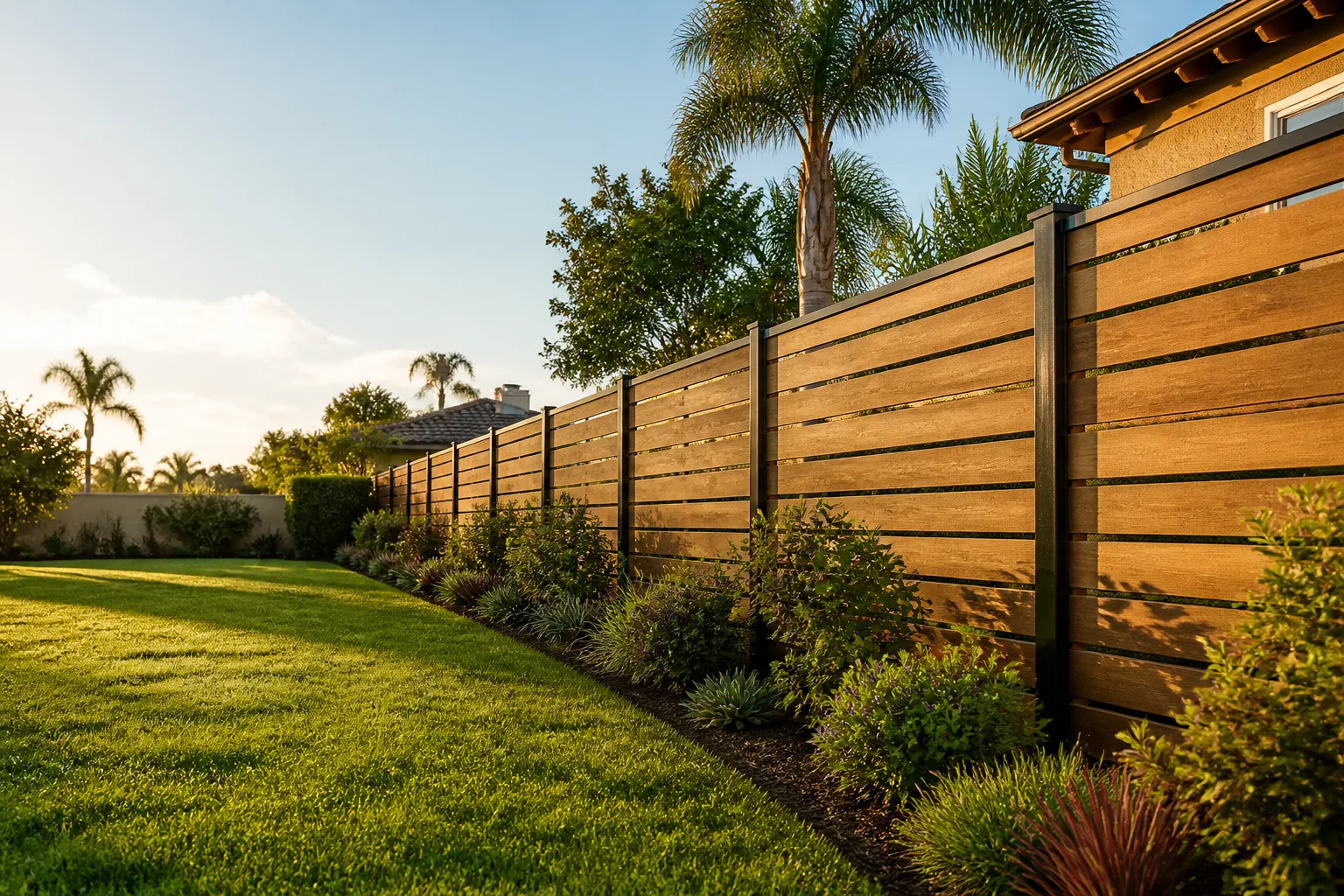
Wood fence that lasts in Garden Grove gets sealed on the front end and resealed on schedule. The dry-heat pattern here can pull a light penetrating sealer off in eighteen to twenty-four months, sometimes faster on a south-facing run. What we see most often is a homeowner who got a fence installed, waited four years, and then called us because the pickets had dried and split. The pickets were fine structurally, but the top of every board was checking and the grain had opened up.
What a redwood or cedar fence needs in our climate:
- Penetrating sealer or oil-based stain every eighteen to twenty-four months in this climate. Reapply sooner on a fence line that faces full sun with no shade, sometimes every twelve to fifteen months. If you can see the wood grain through the finish, it’s a penetrating sealer. If the finish sits like paint on top, it’s a film-former, and that’s a different maintenance path.
- Wash with a garden hose and a soft brush before every reseal. Skip the pressure washer. A pressure washer at high pressure drives water into seams and can raise the grain on older wood. The most common cause of finish failure is a fence that wasn’t cleaned before the fresh coat.
- Check every post base once a year. Even in a dry climate, the post where the sprinkler runs can be wet enough to rot. The bottom twelve inches of a post is where fence failure starts.
- Replace cracked or split pickets as they show up. A split picket looks cosmetic until it’s holding a rail and the whole section goes in a wind.
- Watch the shadow side of the fence where a neighbor’s tree or a shed blocks sun. That side stays damp longer and rots from the bottom. The sun side checks and the shade side rots, which is why the two sides of the same fence often need different attention.
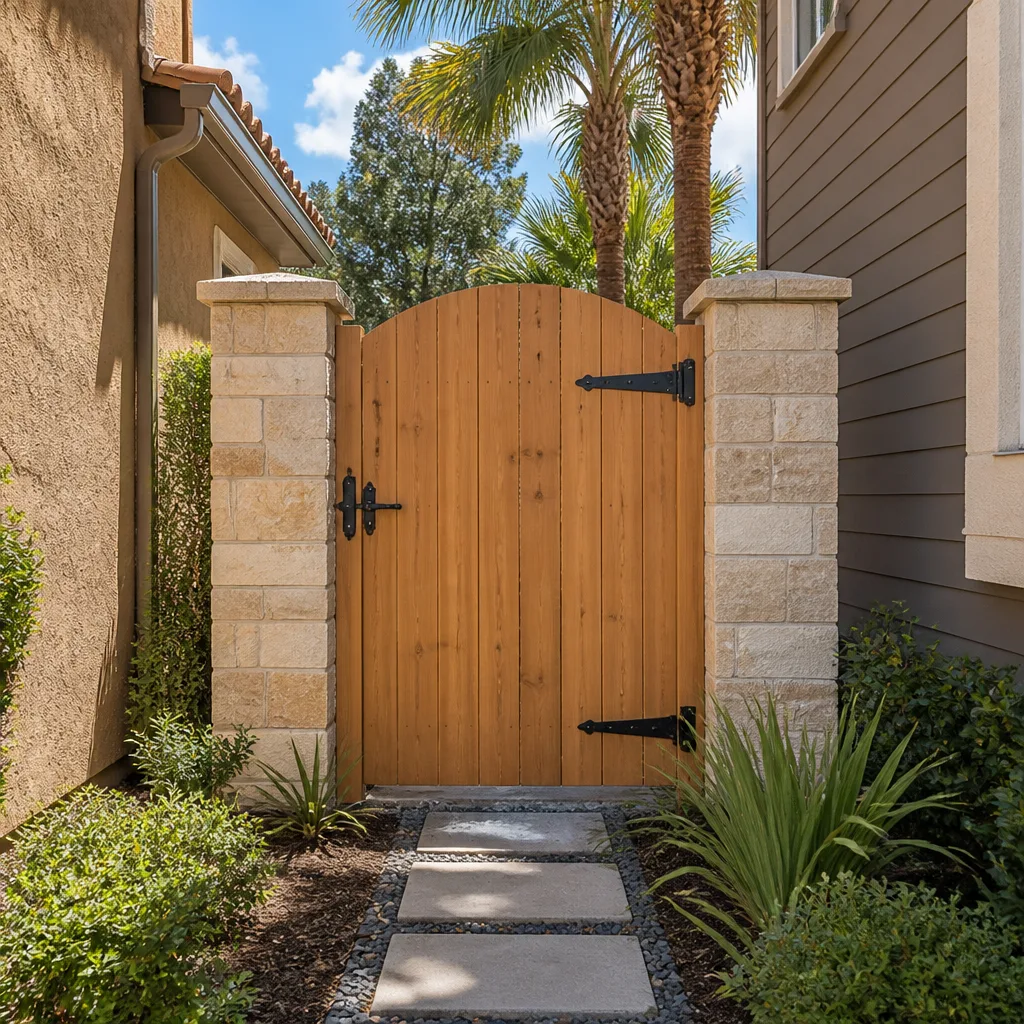
If you’re planning on a new install and want to know what the right material is for a specific yard, Fence Installation in Garden Grove walks through what actually holds up here.
Vinyl Fence Maintenance
Vinyl is the low-effort option, but “low-effort” doesn’t mean “no effort.” In Orange County’s UV load, vinyl will yellow on the sun-facing side after eight to twelve years, and there’s no product that reverses that. What you can do is slow it down and spot damage early.
Vinyl fence in Garden Grove needs:
- One wash per year with a garden hose, mild soap, and a soft cloth. Skip the abrasive pads. Vinyl has a thin protective surface that a scouring pad will dull in one afternoon.
- A post-event walk after Santa Ana winds. The wind event in September or October is when cracked panels and popped rails show up. Vinyl doesn’t fail at the seam; it fails at the panel. A cracked panel will spread faster than you’d expect once it starts.
- Inspect the post caps and the bottom rail every spring. UV degrades vinyl at the parts where it gets direct sun the longest, and the bottom rail that sits in dirt or landscaping is where root heave can stress a post.
- Keep sprinkler heads off the panels. Hard water leaves mineral stains, and on a whitish vinyl panel those marks read as “dirty” even after a wash. Reposition the head or swap to a drip line, which is a landscaping job, not a fence job.
Vinyl is not something you reseal. Once you see heavy yellowing or chalking on the sun side, replacement of the affected panels is usually more cost-effective than an attempted recoat. Vinyl doesn’t accept a stain or seal reliably once the surface has chalked.
Aluminum Fence Maintenance
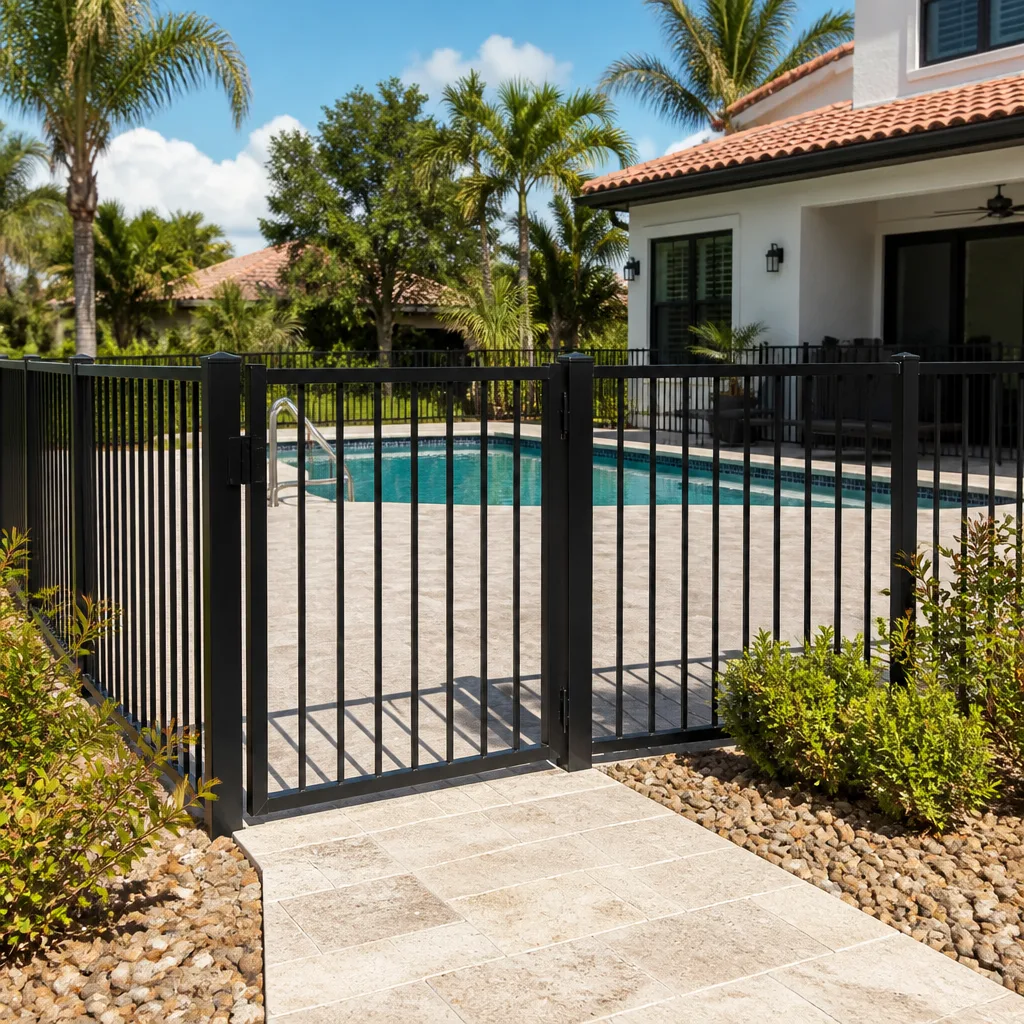
Powder-coated aluminum is the material we get the fewest maintenance calls on, and there’s a reason: it doesn’t rot, it doesn’t split, and in a coastal climate within a few miles of the Pacific it holds up better than bare steel that rusts at weld points. But “almost no maintenance” has two annual tasks that most people skip, and both cause calls we’d rather not get.
Aluminum fence in this climate needs:
- Rinse the panels two to three times a year if you’re within a few miles of the coast, because salt air and marine layer moisture will leave deposits on the powder coat. A garden hose rinse is enough. Detergent isn’t usually needed.
- Check the post caps and the top of every picket after a wind event. A missing cap lets water pool in the post top, which over years can rust out the seam on the interior wall even on coated material.
- Touch up scratches promptly. A scratch that reaches bare metal on a coated aluminum fence will corrode first and the corrosion spreads under the powder coat, lifting the finish off surrounding metal. A paint touch-up pen in the matching color takes a minute and saves a panel.
- Lubricate gate hinges twice a year on the schedule in the gate hardware section below. This is the aluminum-specific weak point.
For homes in Garden Grove where aluminum fencing runs along a driveway or a side yard, we’ve seen the most maintenance problems from gate hinges that never got oiled. The frame holds up; the hinge fails first.
Block Wall Maintenance
Block walls, masonry fence walls, and concrete or block perimeter walls aren’t the same maintenance animal as wood or metal. A well-built block wall needs attention roughly once every three to five years, and the two things to look for are the ones that matter structurally.
- Crack inspection every three to five years. A hairline vertical crack in the mortar joint can be cosmetic settling. A horizontal crack, or a stair-step crack running through mortar joints diagonally, is worth a closer look. That pattern usually points to a footing issue, not a mortar issue, and it’s the one thing a homeowner shouldn’t try to patch over.
- Efflorescence, the white powder that shows up on block faces, is a normal deposit from water moving through the block. It’s cosmetic. Rinse with a garden hose, and if it returns quickly in one spot, have someone look at where the water is coming in.
- Check the weep holes along the base of a retaining wall every year. Weep holes are the small openings that let water drain. If a landscaping bed or a mulch pile has covered them, water pressure builds behind the wall and that’s where real damage starts.
- Repaint or reseal a painted block wall every five to seven years. Sun-facing walls fade faster; a north-facing wall in Garden Grove will hold paint longer than a wall that gets afternoon sun from one to five.
Block walls are also worth an eye after any significant shake in the region. If you notice a horizontal crack that wasn’t there before, get it looked at. A block wall that’s leaning or cracking should never be patched as a DIY project.
UV Degradation: The Signs Most Homeowners Misread
Here’s where most maintenance guides get it backward: they tell you to look for rot when you should be looking for UV damage, and the two have very different early signs. On a wood fence in a dry climate, UV damage shows up first while the wood is completely dry and structurally sound. That’s the window where fixing it is cheap.
Signs that a wood fence is being degraded by sun rather than by moisture:
- Silver-gray or gray-brown surface color. That’s not “old wood look,” it’s the lignin in the wood breaking down from UV. The wood is losing the material that holds the fibers together. It looks like weathering, and it is, but the structural fibers go with it.
- Small cracks or splits running with the grain, called checks. Checked wood loses capacity fast. A picket top that has checked and split will hold a nail less and less each year.
- Fuzziness or a raised grain when you run a hand down the picket. That’s the wood fibers lifting, which means it wasn’t sealed and the surface is now breaking down instead of holding.
- Finish that has chalked or gone dull (you can rub a hand on it and get a white powder). That finish is dead. It’s offering no UV protection at all, even though it visually covers the wood.
- Sun-facing pickets that feel lighter or softer than the shade-side pickets. UV degradation works through the surface layer; on older wood, a sun-side picket can feel like balsa when it should feel like solid wood.
Moisture rot looks different. It shows up in the bottom twelve inches of a post or the shaded side of the fence, it’s dark and often soft to the touch, and it smells like earth. If you’re looking for decay in a Garden Grove fence, look low and shaded. If you’re looking for UV damage, look high and sun-facing. Most people look in the wrong place.
Gate Hardware: The Two-Minute Schedule That Prevents Most Calls
Eighty percent of the gate calls we get are a hinge or latch problem, not a fence problem. A wood gate that sags in a Garden Grove backyard usually sags because the hinges have never been oiled in three years, not because the gate broke. Two minutes with a can of lubricant twice a year is the highest-value maintenance task on the property.
The two-minute gate maintenance schedule:
- February and August: spray the hinge pins and the latch mechanism with a silicone or lithium grease lubricant. Not WD-40 alone, which is a solvent and not a lasting lubricant. The old trick is to wipe the hinge pins with a rag, spray them, work the gate open and closed ten times, and wipe off the excess.
- Every February: tighten every hinge screw and latch screw. A wood gate in our climate goes through more expansion and contraction in the summer than the wood a lot of national guides assume. Screws loosen from that movement, and once one screw works loose, the other screws on that hinge take twice the load and fail fast.
- After each Santa Ana wind event: check that the gate hasn’t shifted on its hinges. A gate that has square-checked at the corner (two opposite corners touching, the other two with a gap) is a warning that the corner joints are separating. Fix that before it drops.
- Check the post anchors at the hinge side every spring. A gate that’s out of plumb by more than a quarter inch on the hinge post is on its way to a hinge replacement.
- If the gate has a self-closing hinge, test it every time you oil. A gate that should self-close but doesn’t has a hinge that’s probably wearing out, and a gate at the end of a driveway that doesn’t latch is a real safety problem.
This is the schedule that keeps a gate working long enough that it becomes a curiosity instead of a work order. It’s also the schedule that gets skipped most often.
What Protects a Contractor Warranty and What Voids It
Maintenance matters to your fence warranty in a way that almost nobody explains up front. Almost every contractor’s fence warranty covers materials and installation, and it usually does not cover damage that resulted from missed maintenance or an unapproved repair. This is the part homeowners get caught on.
Here’s what typically preserves a fence warranty:
- Following the manufacturer’s reseal or maintenance schedule. A wood fence manufacturer’s warranty will usually state the reseal interval it requires. Miss it, and a claim for premature checking or rot is usually denied because the failure was the maintenance, not the product.
- Using approved products. Sealers that contain a specific additive or that are approved by the fence manufacturer are often named in the warranty. A generic sealed product from the shed section may not qualify. Read the finish spec, and if the paperwork says “must be maintained,” the maintenance has to be on the calendar.
- Reporting damage within the warranty window. A cracked post from a Santa Ana wind event should be reported quickly. Waiting two years usually fails the claim because the manufacturer can’t tell whether the failure was the wind or the waiting.
- Keeping records. Keep receipts from your sealant, note the date you sealed, keep a photo of the finished fence. A written maintenance record is the single most useful item when a warranty claim comes down to a he-said-she-said about whether the fence was maintained.
What commonly voids a fence warranty:
- Attaching anything not approved to the posts or rails, like a dog run, an added gate, or a trellis screwed into the posts.
- Pressure-washing a wood fence at pressure that opens the grain. The fence wasn’t finished that way, and a reseal won’t fix it once the fibers are raised.
- Painting a vinyl or powder-coated aluminum fence. Painting a metal fence voids the finish warranty on the coated product, and it’s usually not reversible without a re-coat.
- Cutting into a post or rail to fit a spotlight, a hose bib, or a mailbox. Every penetration is a moisture entry point and, on a product warranty, an unauthorized modification.
- Letting a shrub or vine grow against the fence. Vines trap moisture. A warranty document often lists “planted against the fence” as excluded. Trim on the maintenance schedule you already keep.
If an existing fence is too far gone for maintenance, a replacement is often the cheaper path. Fence installation in Garden Grove explains what that looks like, and Driveway & Pavers in Garden Grove is the parallel guide for hardscape, which follows its own seasonal calendar. If the fence surrounds a yard where a new project is planned, Home Additions & ADU in Garden Grove walks through how the fence ties into a larger site plan. And the Barrett & Sons Construction Garden Grove home page is where you can see the full picture of how we work.
Common Mistakes to Avoid
- Sealing in November because that’s when the guide said to. The spring seal is what protects the wood through July and August, when the UV load is highest. Sealing in October means the wood has just finished spending four months unprotected.
- Sealing a fence right before a rain. Trapping moisture under the finish is worse than having no finish at all. Check the forecast for a three-day dry window, not just the day of the job.
- Using a pressure washer on wood. A pressure washer at maximum on a wood fence opens the grain and makes it impossible for a new finish to bond. The finish that fails first is almost always the one that followed a pressure wash. Use a garden hose and a soft brush.
- Ignoring the sun-facing side while maintaining the shaded side. In Garden Grove, the two sides of the same fence have two different problems. UV damage on the sun side, rot at the base on the shade side.
- Skipping the hinge oil twice a year. The gate hardware call is the most common and the most preventable. A two-minute oil at the change of seasons is the whole job.
- Painting or stenciling over a warranty finish assumption. Before you paint a powder-coated metal fence or a vinyl fence, check the paperwork. Paint can void the finish warranty, and nobody warns you until you file a claim.
- Letting vines run against the fence line to “hide” it. The vine holds moisture on the fence surface in the exact spot that gets the least sun. A wall of ivy looks better than a fence with rot, until it stops being a choice.
See the difference
 Before
 After
 Before
 After
 Before
 After
When to Call a Professional
Call a professional when any fence post is leaning more than a quarter inch out of plumb, when a gate has to be lifted to close, when you find horizontal cracking in a block wall, or when a wood post is soft at the base. Those are the calls where a half-hour of repair keeps the issue from becoming a fence replacement. We can do the repair; more importantly, the first visit tells you whether it’s a repair or a replacement, and the estimate costs nothing.
Barrett & Sons Construction Garden Grove offers free estimates in Garden Grove and the surrounding Orange County communities. Every job gets the permit pulled and inspected where it’s eligible, every price change arrives as a written change order before work starts, and every job comes with our 90-Day Done Right Promise in writing. Call (833) 703-5196 to schedule your free estimate, and we’ll tell you what your fence actually needs this season.
Frequently Asked Questions
Every eighteen to twenty-four months in most of Orange County, and every twelve to fifteen months on a fence line with full sun and no shade. The dry heat and UV combine to break down a penetrating sealer faster here than in climates with more moisture and milder summers. If the finish has chalked, it’s already overdue. Call (833) 703-5196 for an exact quote on a repair or reseal; estimates are free.
Spring. Late winter into early spring, February through early April, protects the wood through the summer UV season. Fall sealing leaves the wood exposed for the months that do the most UV damage. If you can only do it once a year, do it in spring.
A gray or silver surface with small check marks in the picket tops. That gray color means the lignin is breaking down, and the checks mean the wood is losing capacity in the structural fibers. It looks like weathering, but it’s the beginning of structural loss. A pressure washer and a fresh coat won’t fix a picket that has already begun to check.
Once a year for a wash, plus a walk after each Santa Ana wind event. Vinyl in our UV load will typically yellow on the sun-facing side after eight to twelve years, and no maintenance reverses that. What you can do is delay it with regular washing and check the panels after wind, since cracked panels spread fast.
Yes. February and August, with a silicone or lithium grease lubricant on the hinge pins and latch. Two minutes twice a year is what prevents the vast majority of sagging gate calls. Most gates we’re called about have simply never been oiled.
Yes. Pressure-washing wood, painting powder-coated metal, attaching anything to a post or rail, and skipping the manufacturer’s reseal interval can all void a fence warranty. Keep every receipt for the sealer you use, and read the finish specification in the warranty document before you do the work yourself. Call (833) 703-5196 if you want a second opinion; the free estimate is the cheapest way to protect the warranty.
The Bottom Line
In Southern California, the maintenance calendar bends around sun and wind, not rain and snow. Wood seals in late winter, not fall, which is the whole point of getting the finish down before the UV season does the damage. Vinyl needs a wash and a post-wind walk. Aluminum needs a gate hinge lubrication on the February and August schedule. Block walls need an inspection every three to five years and a look at any horizontal crack. Gate hardware is a two-minute job that catches most sagging gate calls before they happen. Keep it simple, put the dates on the calendar, and the fence you have will outlast the one your neighbor resealed in November.
Written by the team at Barrett & Sons Construction Garden Grove.