Last updated November 18, 2026



Free written scope consultation - allowances, timeline, and change-order rules on paper before a single trade is scheduled
Driveway & Pavers Warning Signs Every Homeowner Should Know
A single sunken paver near your garage apron is rarely just a loose paver. In our experience across Garden Grove, it’s usually the first visible proof that water has been channeling under your base for months, and by the time it looks bad, the damage underneath is already widespread. That’s the frustrating part about paver driveways: the failure you can see is the last stage of a problem that started a year or two earlier. This guide walks you through the specific warning signs to watch for, what each pattern actually means, and which ones need a contractor’s eyes within 30 days before you’re looking at a full base replacement instead of a spot repair.
Quick Answer
The main warning signs your paver driveway is heading toward expensive failure are: a single paver or small cluster sinking near the garage, edges spreading wider than the center, dark staining that follows low spots rather than drainage paths, and polymeric sand washing out repeatedly. Settling in one isolated spot points to a water channel under the base. Gaps opening at the driveway’s edges point to failing edge restraint. Either one caught early is a repair; ignored for two years, it’s a full base replacement.
Styles & brands we work with
- Kitchen remodeling
- Bathroom remodeling
- Home additions & ADU
- Roofing
- Windows & doors
- Driveway & pavers
- Fence
Table of Contents
- Why One Sinking Paver Is Rarely Just One Paver
- How to Read Settling and Heaving Patterns
- Why Gaps Open at the Edges First
- What Staining Patterns Tell You About Water Under the Base
- Sand Loss vs. Sand Displacement
- Watch-and-Wait vs. Call Within 30 Days
- Why Garden Grove Soil and Climate Accelerate the Problem
Why One Sinking Paver Is Rarely Just One Paver
When a homeowner points at a single low paver near the garage and asks whether it can just be lifted and reset, the honest answer is usually: we can, but it’ll be back within a season unless we figure out why it sank. A paver doesn’t sink into nothing. It sinks because the bedding layer and a slice of the compacted base underneath it have lost their density, and the most common thief of base density is moving water. Once water finds a path under the pavers, it works along that path, and the paver at the garage door is often just the spot where that path happens to surface.
Here’s how to test the “one paver” idea yourself before calling anyone:
- Stand at the sunk paver and look across the surface at a low angle, almost flat with the pavers, toward the street. A single low paver will show one dip. A water channel will show a shallow trough running toward it.
- Press on the pavers on either side of the dip. If they rock or feel hollow, the bedding layer around them has loosened too, which means the problem is bigger than one stone.
- Check the slope. Driveways should drain away from the garage. If water is pooling near the apron, that pooling is what’s loosening the base.
- Look for a hairline crack in the garage apron or a wet stripe after rain that seems to point at the sunk paver.
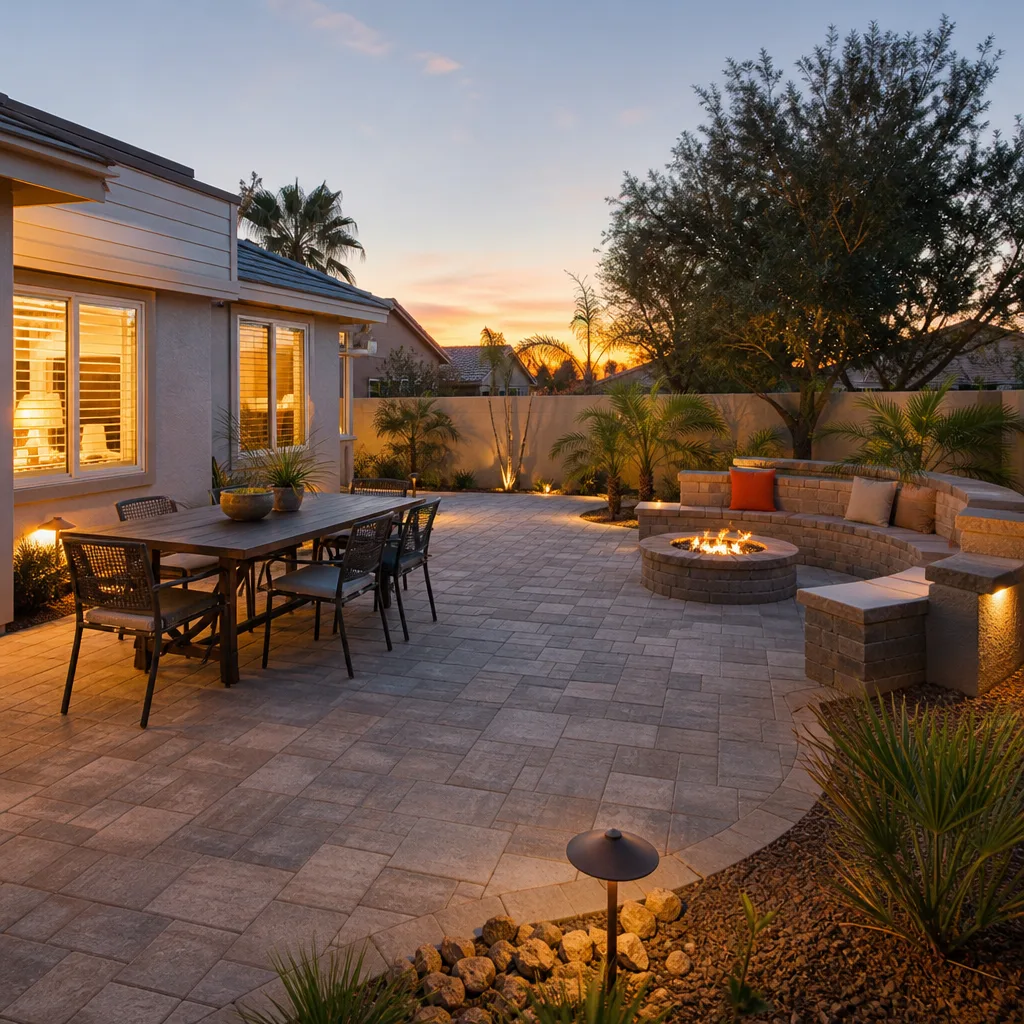
If steps one through four all point the same direction, that paver is a symptom, not a problem. The real work is resetting the whole affected area, re-compacting the base, and correcting the drainage that started it. This is the same logic we apply on the hardscape side of any Barrett & Sons Construction Garden Grove home project: fix the cause, not the stone.
How to Read Settling and Heaving Patterns
The shape of settlement is the best clue to its cause. Two driveways can each have a dip and need two completely different fixes. Before you call anyone, sketch a rough map of what you see and note where the dips and ridges sit relative to the garage, trees, and gutters.
- A single round dip near a tree: usually roots. As roots grow under a compacted base, they lift and shift pavers unevenly. Dips that follow a tree’s canopy outline are almost always root-driven.
- A long, shallow trough running downhill: water channeling under the base. This is the most common cause we see in Garden Grove, and it usually starts at a downspout, an apron joint, or a low spot in the street gutter.
- Pavers heaving up in a ridge or peaked line: soil movement, often clay expansion after wet winters, or roots pushing from below. A ridgeline that runs across the driveway usually means something is pushing rather than settling.
- Broad settling across the entire driveway: base compaction issue. If the whole surface has dropped an inch or more evenly, the base was never compacted deep enough to begin with.
- Wavy settlement that follows the tire tracks: traffic plus weak base. This usually shows up in driveways that were laid over old gravel or dirt with a thin base.
Write down what kind of dip you’re looking at and where it sits. When you call for an estimate, that one sentence saves a whole site visit and gets you a straighter answer about what the repair will involve.
Why Gaps Open at the Edges First
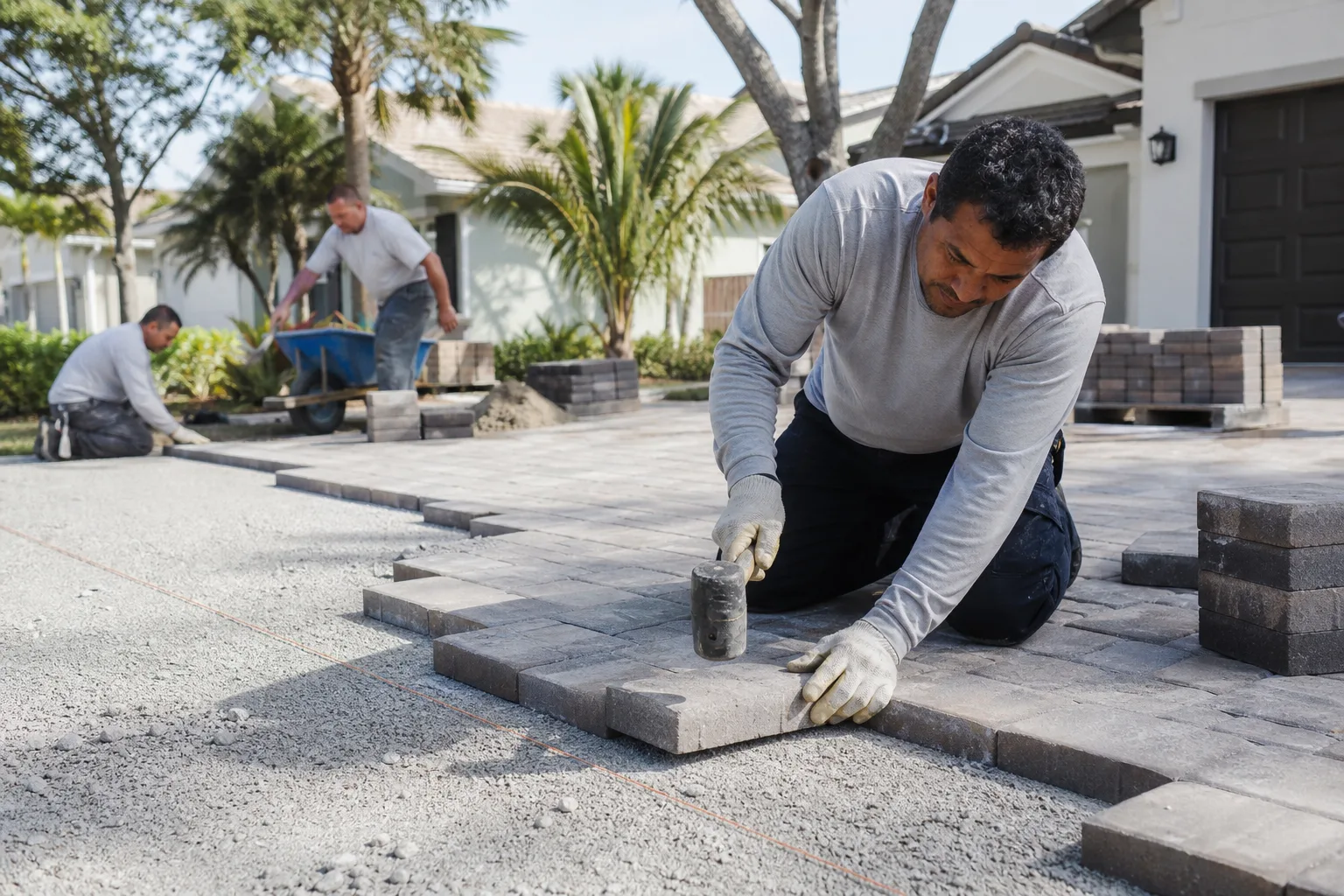
Edge restraint is the hidden hero of every paver driveway. It’s the strip of aluminum, plastic, or poured concrete holding the outer row of pavers locked tight against the sideways push of traffic. When it fails, the pavers spread outward. And because the center of the driveway stays pinned by the weight of cars, the first place that failure shows up is the outer edge.
This is why edge gaps are a load-bearing warning sign, not a cosmetic one. Here’s what to look at:
- Walk your driveway’s outer row and check the joint width between the last paver and its neighbor. On a healthy driveway, that joint is the same as anywhere else, roughly 1/8 to 1/4 inch. On a failing driveway, it’s 3/8 inch or more.
- Look at the edge restraint itself, if it’s visible. A restraint that’s lifting, cracked, or pulled away from the pavers has already given up.
- Check the sand joint at the outermost row. If it’s missing or gone twice as deep as the interior joints, the driveway is spreading and the sand is falling into the void.
- Look at the turf or soil beyond the restraint. Soil settling away from the edge is a sign the pavers have pushed outward over the years.
Edge restraint failure is one of the easiest problems to fix early and one of the most expensive to fix late. Re-pinning or replacing restraint can often be done in a few hours. Rebuilding a spread driveway base takes considerably more. This is the same conversation we have with neighbors about fence posts and their footing: the part you can’t see does all the actual work. If your driveway edge sits close to a shared property line, our team installs and repairs Fence Installation in Garden Grove and can walk both problems at once.
What Staining Patterns Tell You About Water Under the Base
Not all stains are the same, and telling them apart is one of the most useful skills a homeowner can develop. Surface runoff leaves a stain you can scrub. Standing water underneath the base leaves a stain that keeps coming back, because the water is rising from below.
- Hard-water deposits (white, chalky, powdery): surface water evaporating and leaving minerals behind. Common and mostly cosmetic. Lives near sprinkler heads and gutter drips.
- Surface runoff stains (brown, mud-colored, streaky): soil washing across the pavers after heavy rain. Usually follows the slope from a higher spot on the yard. Not a base problem unless it’s happening in bulk.
- Standing water stains (dark, patchy, damp-feeling after dry spells): water rising from under the base. These stains sit in low spots, feel cool to the touch when everything else is dry, and grow darker after any rain. If a stain only dries out after days of full sun, there’s water sitting under your base.
- Efflorescence on the sides of pavers (white salt crust at the joint lines): moisture wicking up through the pavers. It can come from sprinkler overspray, but when it’s happening across a whole low area, it’s usually coming from below.
Staining that grows and returns is the single most reliable early sign that water is sitting where your base layer should be dry. Under your pavers, water under the base is a countdown clock. Take a photo of the stain every month for three months and compare. If it’s growing, that’s your sign to get it looked at.
Sand Loss vs. Sand Displacement
Polymeric sand is the material in the joints that locks the pavers together. It’s designed to lose a small amount every year from rain, sun, and traffic, and a light re-sanding every two to four years is normal even on a healthy driveway. That’s the sand-loss side of the line. Displacement is different.
Here’s how to tell them apart:
- Uniform loss is normal. If the joints across the whole driveway are 1/8 to 1/4 inch deep and fairly consistent, that’s just wear. Re-sand in the spring.
- Localized loss is a signal. If one area’s joints are 1/2 inch deep or more while the rest are shallow, water is washing it out from a specific point.
- Gaps at the edges are a signal. Sand disappearing at the outer rows, especially near the restraint, means the driveway is spreading and the sand is draining out through the widening joints.
- Sand piling at the street is a signal. If you find a pile of polymeric sand at the bottom of the driveway after rain, it’s not the whole driveway bleeding; it’s a specific outlet point.
- Pockmarked surface with sand voids in straight lines is a signal. That pattern usually maps to a seam in the base or the edge of a repair patch, and it’s how water escapes.
If you’re re-sanding every spring in the same spots, that’s not maintenance; it’s an early warning. Fix the water path first, or you’re just replacing the evidence.
Watch-and-Wait vs. Call Within 30 Days
Not every sign needs a contractor next week. Some just need a note on the calendar and a photo. Here’s the short version we give every homeowner in Garden Grove:
Watch-and-wait (unless something changes):
- Uniform polymeric sand loss across the whole driveway.
- Light efflorescence near sprinkler heads or gutter drips.
- A single isolated dip less than 1/4 inch deep with no change over six months.
- Cosmetic surface staining that scrubs off.
Call within 30 days:
- Any sink that has visibly deepened since you first noticed it.
- Any gap opening at an edge wider than 3/8 inch.
- Standing water staining that keeps returning after rain.
- Polymeric sand washing out from a single area more than once in a year.
- Pavers rocking underfoot, or a hollow sound when you tap them.
- A ridge or heave rising across the driveway where none was before.
The line is simple: watch-and-wait is for things that stay the same. Call within 30 days is for anything that’s getting worse. The difference in cost between an early repair and a full base replacement in Garden Grove is often thousands of dollars, so it pays to be honest with yourself about which list you’re on.
Why Garden Grove Soil and Climate Accelerate the Problem
Garden Grove sits on a mix of sandy loam and clay-heavy soil, and the combination matters. The clay swells when wet and shrinks when dry, and our wet winters followed by long dry summers push and pull on paver bases in a way that inland desert climates don’t. Driveways in older neighborhood pockets like the ones near Chapman Avenue or off Brookhurst see more base movement than driveways built on better-drained lots. Combine that with tree roots from mature ficus, liquidambar, and jacaranda, and a Garden Grove driveway faces more stress than the same materials installed a few miles inland on a different soil type.
That’s why we check drainage and soil type as part of any assessment, not just the paver surface. When we look at a driveway on a lot with a shared fence line and a low corner, we often find the drainage issue and the fence footing issue at the same time. Fixing both together is usually cheaper than fixing them separately, and it protects the improvements you make. When a driveway repair is part of a bigger property improvement, our team also handles Home Additions & ADU in Garden Grove projects where grading and new hardscape need to be planned together from day one.
Common Mistakes to Avoid
- Resetting one sunken paver without fixing the base. The paver will sink again within a season unless the water channel and base compaction underneath are addressed. Reset one paver and you’ll be resetting it again next spring.
- Re-sanding the whole driveway to hide a spreading edge. The fresh polymeric sand will look great for six months, but if the edge restraint is failing, that new sand just gets washed into the same void. Fix the restraint first.
- Sealing a driveway that’s still wet underneath. Sealer traps moisture in the base and makes the failure faster. Any sealant applied over stained, damp pavers is sealing in the problem.
- Assuming the whole driveway needs replacing. On many Garden Grove driveways, we can repair the affected area and rebuild the base under it while leaving the healthy pavers intact. Replacement is the last resort, not the first estimate.
- Ignoring the downspout or apron joint. Most of the water under a Garden Grove driveway starts from a downspout that dumps too close to the pavers. Moving the outlet is often cheaper than any paver work.
- Hiring a paver installer who skips the base inspection. Anyone who quotes pavers from the curb without pulling up a paver and looking at the bedding layer is guessing. Base condition is where the cost difference lives.
- Treating edge gaps as cosmetic. A 3/8 inch gap at the edge widens. A 3/8 inch gap today is a base rebuild in two or three years. Get it looked at before the next rainy season.
See the difference
 Before
 After
 Before
 After
 Before
 After
When to Call a Professional
Call a professional when you can see a sink that’s deepening, an edge opening wider than 3/8 inch, polymeric sand washing out from a single area more than once in a year, or a standing-water stain that keeps returning after rain. Those are the signs we see lead to full base replacement if left a second season, and every one of them is cheaper to fix in the first year. Barrett & Sons Construction Garden Grove offers free estimates in Garden Grove. Our team has up to 28 years of experience on hardscape and driveway jobs, and we carry premium brands like Belgard and Techo-Bloc when a rebuild is the right call. Call (833) 703-5196 to schedule a walk-through and get a written line-item scope before deciding anything. If you’d like to see how we handle the rest of the hardscape package, our Driveway & Pavers in Garden Grove team handles repair, replacement, and new install.
Frequently Asked Questions
A spot repair on a sinking paver or small area typically runs a few hundred dollars, while a base rebuild on a full driveway section runs into the low thousands. The difference depends almost entirely on how much base area is compromised, which is why we recommend a base inspection before any repair quote. Prices on a Garden Grove driveway we can walk and measure are more accurate than anything quoted by phone. Call (833) 703-5196 for a free estimate.
A well-installed paver driveway with a properly compacted base, functioning edge restraint, and reasonable drainage routinely lasts 25 years or more, often much longer with periodic re-sanding every two to four years. Driveways that fail early almost always fail because of the base, not the pavers. If your driveway is showing signs at 10 to 15 years, that’s usually a base or drainage issue, not a lifespan issue.
You can lift and re-bed a paver, but if the base underneath is compromised, the repair won’t hold. The part of the job that actually matters is re-compacting the bedding and correcting the water path that caused the sink. We’ve seen DIY resets last one season and then fail faster than before because the water channel was never fixed. If you want to try it on a small cosmetic issue, do it; but for anything deeper than 1/4 inch, get a base inspection first.
Normal sand loss is uniform across the whole driveway and shows up as joints 1/8 to 1/4 inch deep. A drainage problem is localized: deep joints, sand piling at the street after rain, or sand washing out of the same spot more than once a year. If the loss is uneven, it’s drainage. Call (833) 703-5196 for a walk-through if you’re not sure which one you have.
The signs are a stain that keeps returning after rain, pavers that feel cool or damp after dry days, and hollow sounds when you tap them. A sink that only shows up near the garage or at a low corner is another strong indicator. If the water is coming from a failing downspout or an apron joint, the fix is often simpler than a full rebuild, so it’s worth getting checked before you assume the worst.
Interior driveway repairs generally don’t require a permit, but if the work touches the driveway apron at the street or involves changes to the drainage that affects stormwater flow, it may. We pull permits and pass inspections on every eligible job, and we’ll flag any permit needs in writing before the work starts. If you’re in an unincorporated pocket of Garden Grove with different rules, that gets checked too.
A small spot repair is usually a day. A partial base replacement can run two to four days depending on how much area is affected and how much polymeric sand needs to cure. Full driveway rebuilds run longer and we schedule them as written scopes with a clear start and finish date. Whatever the timeline, we put it in writing before we start, because a scope that isn’t on paper is a surprise waiting for a date.
The Bottom Line
A paver driveway tells you it’s failing a full year or two before it fails. The signs are one sunken paver near the garage that’s actually a water channel, gaps opening at the edges before the center shows anything, staining that keeps returning in the same low spots, and polymeric sand washing out unevenly instead of uniformly. Watch the ones that stay the same. Get a contractor’s eyes on the ones that are getting worse, ideally within 30 days. Our team at Barrett & Sons Construction Garden Grove answers the phone 24/7, pulls the permits on every eligible job, and backs every completed job with our written 90-Day Done Right Promise. Call (833) 703-5196 to schedule a free estimate and get a scope in writing before anything moves.
Written by the team at Barrett & Sons Construction Garden Grove.